
This post contains affiliate links. If you buy through them, we may earn a small commission at no extra cost to you. As an Amazon Associate, Gerzsi earns from qualifying purchases. Read our disclosure. Tamás is a real head chef with 25 years in professional kitchens; Gerzsi is his cartoon beaver apprentice. The illustrations and kitchen stories are just for fun; the test results come from the independent reviewers linked below.
📖 The story behind this guide: Gerzsi’s first forty carrots at The Riverbank Inn (Stop 2 of 10), and the day his little sister Twig asked Chef Tamás how to hold a knife. Read the tales, then come back for the gear. · See the adventure map
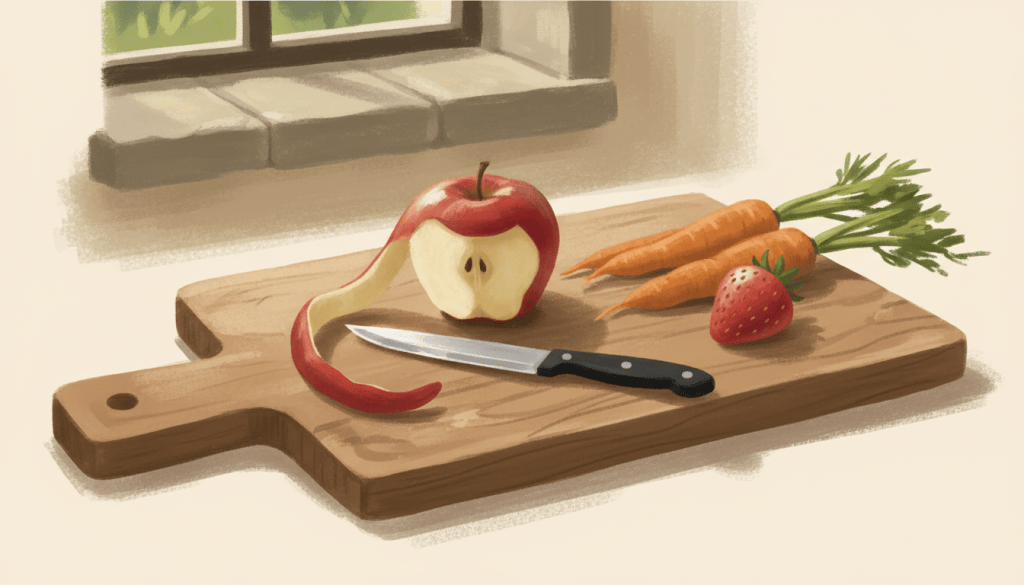
From the kitchen: My first job at the Riverbank Inn was forty carrots. I used my teeth. Chef Tamás set one chewed carrot down on the board, very slowly, and handed me a knife instead. Later my little sister Twig asked him how to hold one before her first pizza night, and he showed her the claw grip. Knuckles forward, fingertips tucked. This guide is about the smallest knife on the line, the one that does the jobs a big blade can’t.
The short answer
Best for most people: Mercer Culinary Renaissance 3.5″. America’s Test Kitchen’s winner, a forged knife that was “solid, well-made, and agile, excelling at every task we gave it” ($25–50).
If you want to spend less: Victorinox Swiss Classic 3.25″. ATK’s Best Buy and Reviewed’s Best Value, and ATK says it has “proved its value again and again over the years” (under $25).
If you want the heirloom: Wüsthof Classic 3.5″. Reviewed’s Best Overall and recommended by ATK. Forged in Solingen, and priced like it ($50–100).
Why these? The test results are below, with links to every source.
A chef’s knife does most of the work in a kitchen. A paring knife does the fiddly rest: hulling strawberries, peeling an apple in your hand, digging the eyes out of a potato, trimming the fat off a chicken thigh, cutting the string off a roast. A good one can cost less than a pizza, it lives in the drawer, and most people grab it ten times a day without thinking about it. That is a good reason to pick a decent one.
We didn’t test these ourselves, and Chef Tamás hasn’t reviewed them, so the rankings are the testers’, not his. Two independent test kitchens did the testing, and we read both. America’s Test Kitchen had five cooks mince shallots, hull strawberries, cut oranges into supremes, peel and core apples and slice a block of cheddar with each knife, and measured the edge with an industrial sharpness tester before and after. Reviewed had a trained chef peel apples and segment oranges in the air, mince shallots on the board and devein shrimp with ten knives. Where the two agree, we trust it. Where they don’t, we say so.
Quick picks
The four knives, side by side
| Paring knife | Price range | Who it’s for | Tester verdict |
|---|---|---|---|
| Mercer Culinary Renaissance 3.5″ · Check price on Amazon | $25–50 | Most home cooks who want a forged knife without the forged price | ATK winner: “excelling at every task we gave it” |
| Victorinox Swiss Classic 3.25″ · Check price on Amazon | Under $25 | Anyone. Buy two, lose one, shrug | ATK Best Buy: “proved its value again and again”; Reviewed Best Value: “rivaled most of its more expensive competitors” |
| Wüsthof Classic 3.5″ · Check price on Amazon | $50–100 | Cooks who already own a Wüsthof and want the set to match | Reviewed Best Overall: “perfectly balanced handle”; ATK recommended: “excelled at off-the-board tasks” |
| Zwilling Pro 4″ · Check price on Amazon | $50–100 | Big hands | ATK recommended: “Large-handed testers loved this paring knife’s extra-long handle and tall heel” |
ATK = America’s Test Kitchen. Blade lengths are what the makers call them; ATK measured the Wüsthof at 3.25″ and the Zwilling at 3.8″.
What a paring knife is for
Everything a big knife is bad at. Think of the jobs you do holding the food in one hand instead of on the board: peeling, coring, trimming, taking the green top off a strawberry. ATK calls these “off-the-board tasks,” and they are where a short, narrow, pointy blade earns its spot. On the board it still works for a shallot or a garlic clove. For an onion, forty carrots or anything bigger than your fist, put it down and pick up the chef’s knife.
1. Mercer Culinary Renaissance 3.5″: the testers’ winner
America’s Test Kitchen put this on top of its lineup. Their summary: “Our top paring knife is solid, well-made, and agile, excelling at every task we gave it” (America’s Test Kitchen). It’s a forged knife, which usually means more money, but ATK listed it in the $25–50 range, and the restaurant supplier KaTom had it for just under $25 in October 2026 (KaTom). Mercer says the blade is high-carbon German steel forged from one piece, with a triple-riveted Delrin handle and a limited lifetime warranty (Mercer Culinary).
Reviewed didn’t test this exact knife. It tested Mercer’s Genesis 3.5″, a cousin with a rubbery handle, and found “the blade was impressively sharp for such an inexpensive knife,” with weight as the main complaint (Reviewed). Same brand as the budget chef’s knife this site keeps recommending, which is a nice coincidence and nothing more.
Good for: most home cooks who want a forged knife without the forged price. Not for: anyone who wants the lightest knife possible. Forged blades are heavier.
2. Victorinox Swiss Classic 3.25″: the cheap knife everyone agrees on
Plastic handle, thin stamped blade, made in Switzerland, dishwasher safe, and under $25 on Victorinox’s own site in October 2026 (Victorinox; it was out of stock there when we checked). Victorinox lists the blade at 3.1 inches, a little shorter than the 3.25″ in the name.
Both test kitchens picked it as the value knife. ATK made it the Best Buy: “This inexpensive paring knife has proved its value again and again over the years” (America’s Test Kitchen). Reviewed named it Best Value and said “this sharp blade rivaled most of its more expensive competitors” (Reviewed). It won’t feel like a forged knife, because it isn’t one. It will feel like a knife you can hand to a kid learning the claw grip without holding your breath about the price.
Good for: anyone. Buy two, lose one, shrug. Not for: cooks who want the heft and stiffness of a forged blade.
3. Wüsthof Classic 3.5″: the forged one that costs real money
Reviewed’s Best Overall. Its chef-tester wrote that it “immediately pulled away from the pack with its perfectly balanced handle and streamlined design” and called it “completely worth it” (Reviewed). ATK ranked it lower, as recommended rather than the winner, but agreed it “excelled at off-the-board tasks” like peeling (America’s Test Kitchen).
The catch is the price. Reviewed’s article puts it in the $25–50 range, but Cutlery and More listed it in the $50–100 range in October 2026, and so did ATK (Cutlery and More). For that you get a full-tang forged blade of X50CrMoV15 steel at 58 HRC, made in Solingen, Germany. It is a lovely object. It also costs about as much as a drawer full of Victorinox knives.
Good for: cooks who already own a Wüsthof and want the set to match. Not for: anyone on a budget. The Mercer won ATK’s test for much less.
4. Zwilling Pro 4″: for big hands
Why a 4-inch knife is a real choice, not a size up
ATK recommends the Zwilling Pro for one specific group: “Large-handed testers loved this paring knife’s extra-long handle and tall heel” (America’s Test Kitchen). ATK listed it in the $50–100 range. Reviewed didn’t test the Pro; it tested Zwilling’s Four Star 4″ and found “the 4-inch blade was just a bit too long and it struggled on precision tasks like segmenting oranges,” while liking the handle (Reviewed). Read those two together and the advice is simple: if a 3.25″ handle disappears in your fist, go 4″. If not, don’t.
Good for: big hands. Not for: precision work like segmenting oranges, if a 3.25″ handle already fits you.
The one both testers passed on
The Opinel No.112 is the charming wooden-handled knife in every gift shop. ATK put it in Not Recommended: “Several testers commented that this inexpensive, lightweight knife looked like a toy” (America’s Test Kitchen). Reviewed ranked it last of ten and said “it just wasn’t as sharp as some of the competition” (Reviewed). Keep it for picnics.
Chef Tamás’s note: His home-cook rule, from our sharpening guide: hone often, and when the knife is truly dull, take it to a professional instead of experimenting on it. The knives he uses on his own shifts are in the seven-knife challenge. He hasn’t reviewed the paring knives in this guide, so the rankings above are the testers’, not his.
Paring knife FAQ
3.25 or 3.5 or 4 inches?
For most hands, 3.25 to 3.5. ATK’s winner and Best Buy are both in that range, and Reviewed found the 4-inch Zwilling Four Star too long for citrus work. Go to 4 inches only if the shorter handles feel cramped.
Forged or stamped?
Forged knives (Mercer Renaissance, Wüsthof Classic) are heavier and stiffer. Stamped knives (Victorinox) are light and a little flexible. On a paring knife the difference matters less than on a chef’s knife, because you’re not chopping through anything hard. Reviewed did ding Wüsthof’s cheaper Pro model for being “really flexy,” so very thin stamped blades can go too far.
Does it need a serrated edge?
No. A serrated paring knife is a different tool for tomatoes and crusty things. This guide is straight edges only, so the table compares like with like.
Can a kid use one?
With an adult next to them and the claw grip Twig learned, a small knife is easier to control than a big one. Start with soft food, a board that doesn’t slide (see the cutting board guide) and the cheap knife, not the heirloom.
The bottom line
Buy the Victorinox and stop thinking about it, or buy the Mercer Renaissance if you want the forged knife that won ATK’s test, still in the $25–50 range. The Wüsthof is for people who already know they want a Wüsthof. Whatever you pick, keep it honed, keep your fingertips tucked, and leave the carrots to the knife.
Tester-ranked. Beaver-approved.
Read next
- Best chef’s knives under $100 (the big knife that does the other 90 percent)
- How to keep a kitchen knife sharp
- The seven-knife challenge: budget knives on a real shift
🦫 The Lodge Letter. One new adventure a week and one tested pick from the chef’s kitchen. No spam, he’s a beaver.
Sources
- America’s Test Kitchen: The Best Paring Knives (published September 3, 2025)
- Reviewed: The Best Paring Knives, tested by Lindsay D. Mattison
- Mercer Culinary: Renaissance 3 1/2″ paring knife (specs, warranty)
- KaTom: Mercer Culinary M23540 listing
- Victorinox: Swiss Classic paring knife 6.7601 (specs)
- Cutlery and More: Wüsthof Classic 3.5″ paring knife (specs)
Price ranges checked in October 2026; prices change often. Serious Eats and Wirecutter also publish paring knife tests, but we couldn’t read them when this guide was written, so nothing here is attributed to them.
🛒 Shop this guide
Paring knives
Affiliate links. Rankings come from America’s Test Kitchen and Reviewed, linked in the guide.



Leave a Reply