This post contains affiliate links. If you buy through them, we may earn a small commission at no extra cost to you. Read our disclosure.
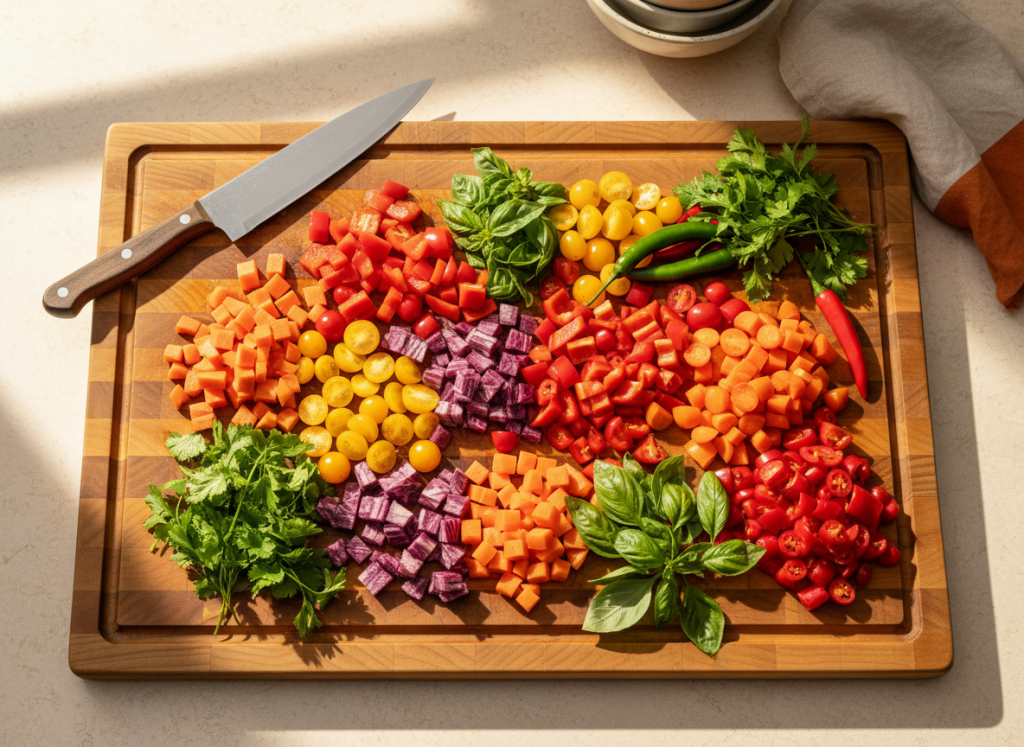
Your cutting board decides how safe, fast and comfortable your prep is, and how long your knife stays sharp. Yet most home kitchens have a board that’s too small, slides around, or is quietly dulling the knife. Here’s what matters, what I use, and which boards independent testers rate best.
What matters in a cutting board
Chef’s note: Three things, in this order. It must not slip. It must be kind to your knife. And it must be big, bigger than you think you need.
Wood vs plastic: what I’ve learned in professional kitchens
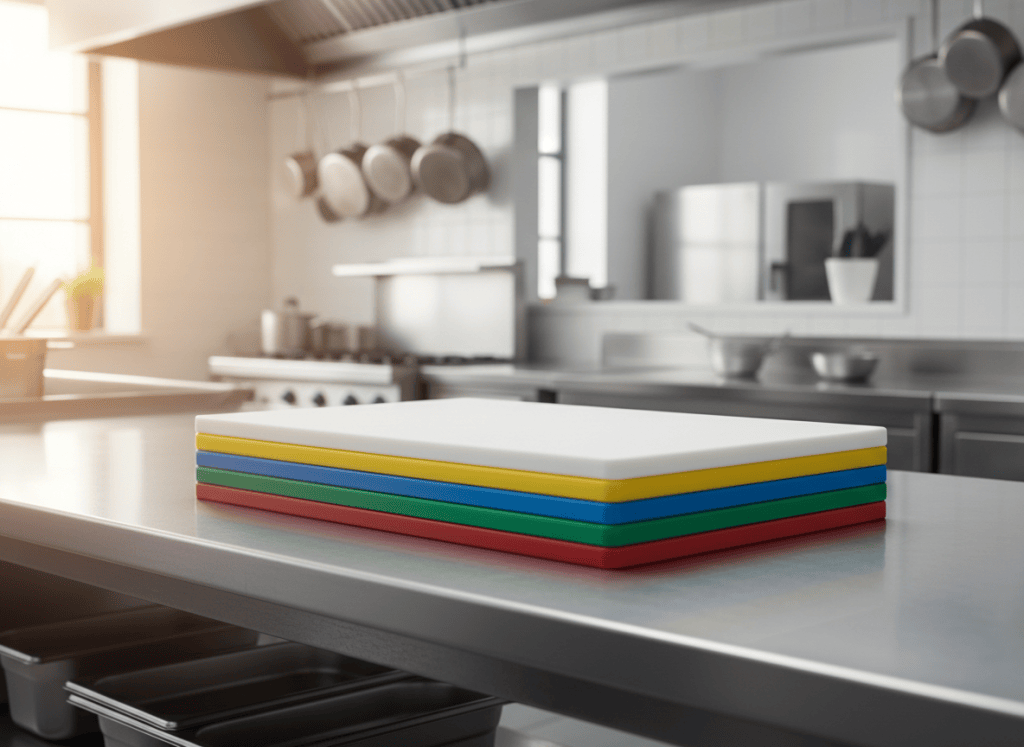
At work we use both: color-coded plastic boards and wooden end-grain and edge-grain boards. At home I use both too. Each has a clear job.
Plastic
- The good: hygienic and dishwasher-safe. In professional kitchens, color coding means raw meat never shares a board with salad, which prevents cross-contamination.
- The bad: it scores over time, and deeply scored boards need replacing. Thin boards warp.
Wood
- The good: kind to your knife edge, and a good heavy board is rock-stable.
- The bad: it needs care. You have to oil it, and the dishwasher will ruin it.
Chef’s note: If you only have room for one board at home, get one big wooden board.
Best wooden board: Teakhaus Edge Grain (XL)
What the testers say: America’s Test Kitchen named it the winner of its wood and bamboo board test. At 18 × 24 inches it gives plenty of workspace, and at about 15 lb it’s heavy enough to stay stable without being too hard to lift. Teak’s natural oils help it resist stains and warping, it needed the least oil of any board they tested, and it’s reversible (America’s Test Kitchen).
One honest caveat from the testers: teak contains tiny silica particles that may dull knives slightly faster than softer woods, though the effect is minimal in everyday home use (America’s Test Kitchen).
- Good for: anyone who cooks most days and has the counter space.
- Skip if: you need to lift it into a small sink often, or want something dishwasher-safe.
Best plastic board: Winco Statik Board 15″ × 20″
What the testers say: America’s Test Kitchen’s large plastic board winner. Four rubberized grips gave it rock-solid stability, its half-inch thickness resisted warping even after 50 dishwasher cycles, and stains and odors washed out (America’s Test Kitchen).
Chef’s note: This is the kind of heavy-duty restaurant plastic board I work with. Thick matters: thin plastic boards warp.
Lightweight plastic pick: OXO Good Grips Carving and Cutting Board
What the testers say: America’s Test Kitchen’s Best Buy in the same test. At just over 3 lb it’s the easiest to handle, and it has a juice groove for carving. The trade-off: it’s thinner, so it bounced slightly during vigorous chopping, could slip occasionally, and temporarily bowed under hot water before returning to shape (America’s Test Kitchen).
3 kitchen tricks I’d pass on to every home cook
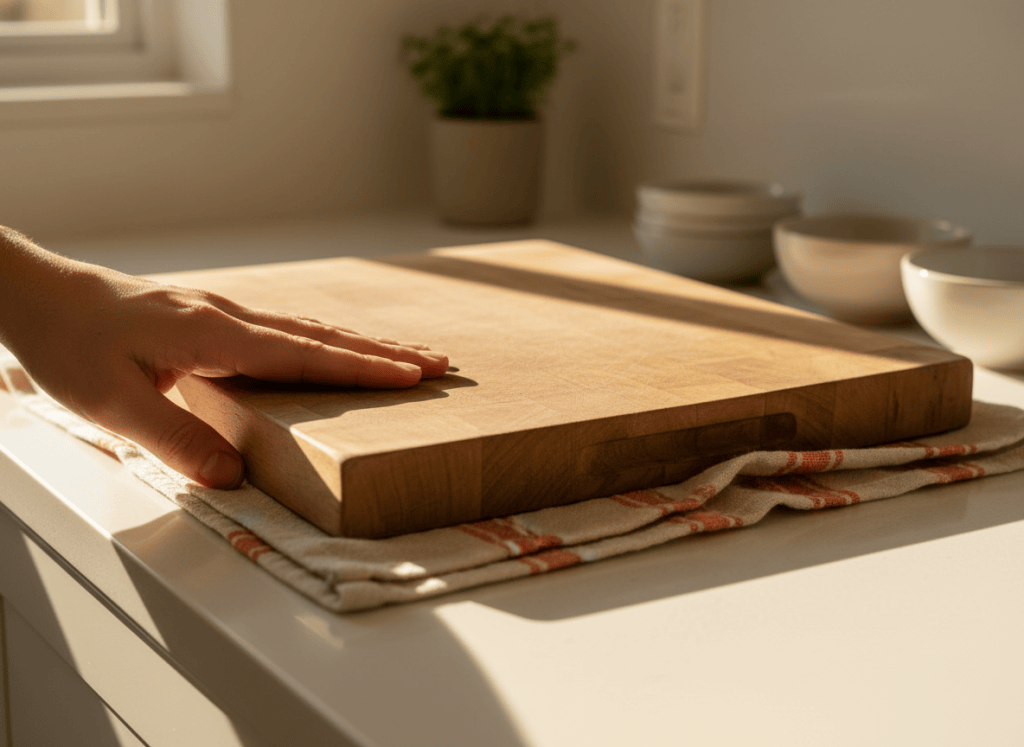
- Put a damp towel underneath. A board that slides is dangerous. A damp cloth or paper towel under it fixes that instantly.
- Buy bigger than you think. A cramped board slows you down and pushes food onto the counter.
- Replace deeply scored boards. Deep cuts are hard to clean properly.
Caring for a wooden board
America’s Test Kitchen’s advice: wash by hand, never in the dishwasher; stand the board on its edge to dry evenly; and rub it with mineral oil regularly to keep it water-resistant (America’s Test Kitchen).
A good board deserves a good knife. See our picks for the best chef’s knives under $100 and how to keep a knife sharp.
The bottom line
For most home cooks, one big wooden board is the best buy: the Teakhaus Edge Grain XL is the tested winner. If you want something you can put in the dishwasher, the thick Winco plastic board is the one that stayed flat and stable in testing.


Leave a comment