This post contains affiliate links. If you buy through them, we may earn a small commission at no extra cost to you. Read our disclosure.
If you cook at home, one good chef’s knife will do most of your cutting. The problem is choosing it: there are hundreds of options, and many “best of” lists are written by people who have never worked a kitchen shift.
This guide works differently. Every performance claim below is linked to a named, independent tester. Where I add my own view as a working head chef, it is clearly marked as a Chef’s note, and I only write those about knives I have actually used. Two of the four main picks I have used for years in professional kitchens; the others are included on the strength of the test results.
Quick picks
- Best overall for most people: Victorinox Fibrox Pro 8″
- Best value: Mercer Culinary Millennia 8″
- Best forged, German-style: Henckels Premio 8″
- Cheapest that still does the job: KitchenAid Classic 8″
1. Victorinox Fibrox Pro 8″ — best overall for most people

What the testers say: America’s Test Kitchen names it its favorite chef’s knife, praising the blade and the grippy, comfortable handle (America’s Test Kitchen). It has also long been Wirecutter’s budget pick (summary via Kitchen Knife Scout), and Reviewed found it kept pace with far more expensive knives in its testing (Reviewed).
Chef’s note: I used this knife at work for years. Its biggest strength is that it survives real kitchen life: dropped, knocked around, washed a hundred times, and still working. The honest downside is that the edge dulls faster than on pricier knives, so plan to hone it often. If you are just starting to cook, or you are a culinary student, this is the knife I would put in your hand first.
- Good for: beginners, students, anyone who wants a knife they do not have to baby.
- Skip if: you want an edge that stays razor-sharp for months without maintenance.
2. Mercer Culinary Millennia 8″ — best value
What the testers say: America’s Test Kitchen lists it as its Best Buy chef’s knife, noting it costs roughly half as much as their top pick while still being a strong performer (America’s Test Kitchen).
- Good for: tight budgets, a second knife, or a first knife for a teenager learning to cook.
- Skip if: you can stretch to the Victorinox, the tested favorite.
3. Henckels Premio 8″ — best forged, German-style

What the testers say: Consumer Reports named the Premio its best chef’s knife overall, and it was the only knife in their test that all four panelists rated positively (Consumer Reports).
Chef’s note: I have worked with Henckels chef’s knives in professional kitchens, though I can’t say which exact line. Compared with the Victorinox, they feel heavier and more stable in the hand, and they hold their edge noticeably longer. The trade-off is the weight: after a long prep session your hand will feel it. If you cook regularly and like a knife with some heft behind the cut, this style is worth it.
- Good for: regular home cooks, people who prefer a heavier, solid-feeling knife.
- Skip if: you have small hands, wrist issues, or do long prep sessions and prefer something light.
4. KitchenAid Classic 8″ — cheapest that still does the job
What the testers say: Consumer Reports picked it as its best budget chef’s knife, calling it a clear value choice for casual cooks (Consumer Reports).
- Good for: occasional cooks, a holiday home, a first apartment.
- Skip if: you cook most days — spend a little more on one of the picks above.
Worth stretching the budget for
Two knives come up again and again in expert testing but were listed above $100 at a major US retailer at the time of writing (Walmart listing):
- Mac MTH-80: Wirecutter’s long-time top chef’s knife pick (via Kitchen Knife Scout).
- Tojiro DP Gyuto: a Japanese knife with a VG-10 steel core, a steel usually found in much pricier knives (Culinary Goods Co.). Shorter sizes are sometimes cheaper.
How to choose
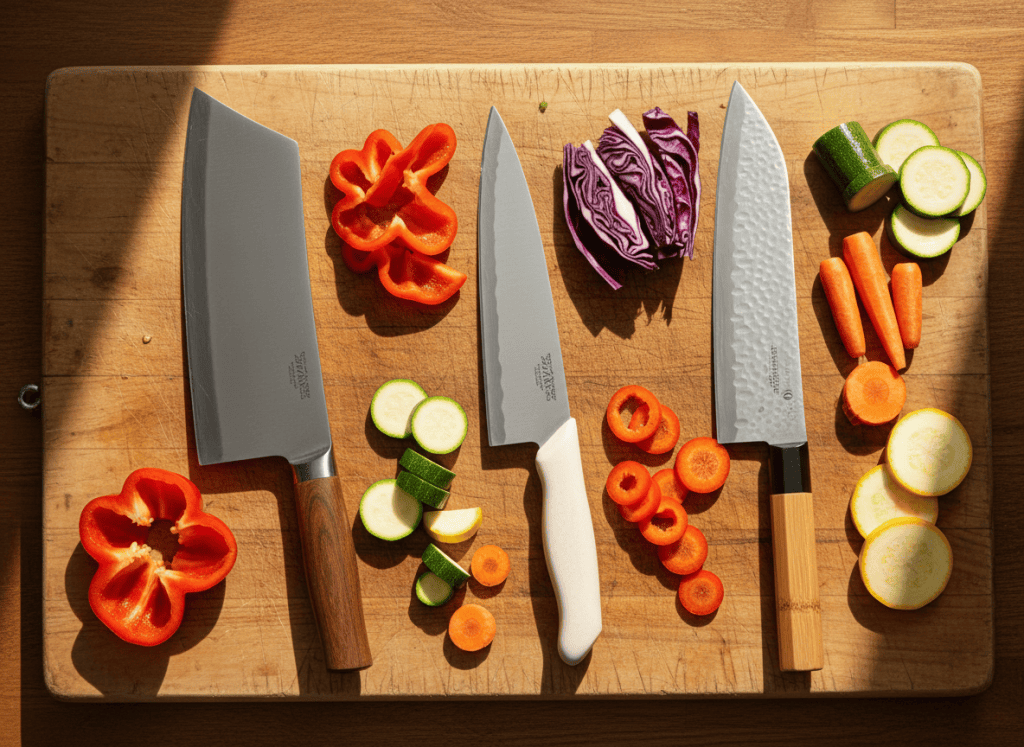
- Length: 8 inches is the standard size and suits most home kitchens. Go shorter for small boards and counters.
- Weight: light knives are nimble and easy on the wrist; heavier forged knives feel stable and do more of the work on hard vegetables.
- Handle: it should stay secure when your hand is wet. Hold it before you buy if you can.
- Maintenance: softer steel is easy to sharpen but dulls sooner; harder steel keeps its edge but is less forgiving.
4 mistakes that ruin a good knife
Chef’s note: Most people who are disappointed in their knife did not buy a bad one. They made one of these mistakes:
- Putting it in the dishwasher. Hand-wash and dry it straight away.
- Never honing or sharpening it. Every knife dulls. A few strokes on a honing steel before cooking makes a huge difference.
- Cutting on glass or stone. Use a wood or plastic board. Hard surfaces destroy the edge fast.
- Storing it loose in a drawer. Use a block, a magnetic strip or a blade guard.
The bottom line
If you only buy one knife, make it the Victorinox Fibrox Pro: it is the tested favorite, and in my experience it takes years of kitchen abuse without complaint. If you cook often and like a heavier knife, the Henckels Premio is the step up. Either way, look after it and it will look after you.


Leave a comment