

This post contains affiliate links. If you buy through them, we may earn a small commission at no extra cost to you. Read our disclosure. As an Amazon Associate, Gerzsi earns from qualifying purchases. Tamás is a real head chef with 25 years in professional kitchens; Gerzsi is his cartoon beaver apprentice. We haven’t tested these ovens ourselves. Every product fact below comes from independent testers, linked inline. The illustrations and stories are just for fun; the chef’s notes are real.
📖 The story behind this guide: Gerzsi’s adventure at The Lake House (Stop 8 of 10 on the river). Read the tale, then come back for the gear. · See the adventure map
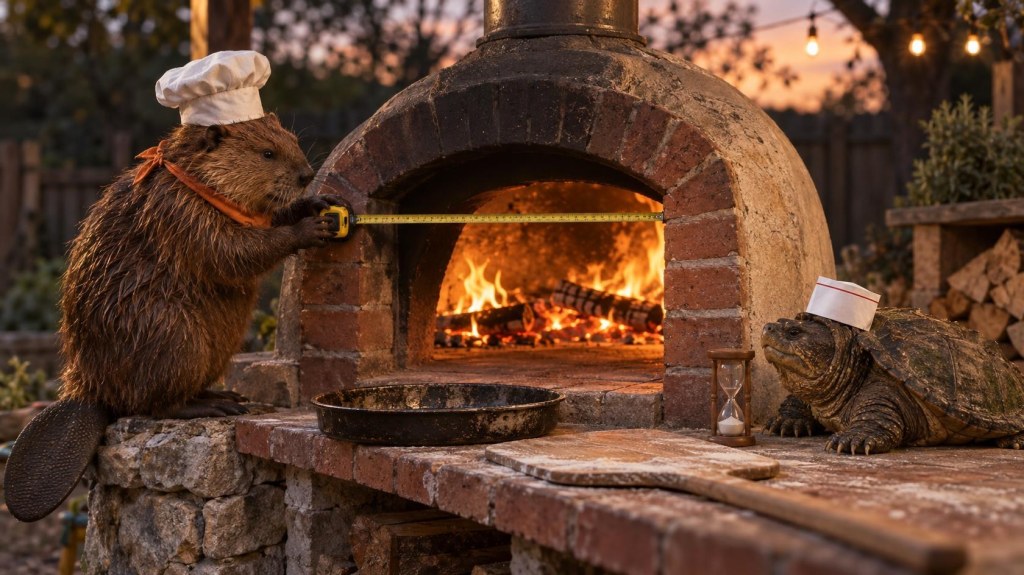
🪐 Fun fact: your pizza oven can beat a planet
Popular Science’s tester saw the Solo Stove Pi Prime go past 900°F at its maximum setting (Popular Science). The surface of Venus, the hottest planet in the solar system, sits at about 880°F (Space.com). So on a good night, the thing on your patio runs hotter than another planet.
Meet Big Tony, our new friend from Chicago: a snapping turtle who has run a brick oven for decades, cuts every pizza with scissors and never, ever touches the stone. “It’s hotter than Venus, kid,” he told Gerzsi. “And Venus don’t have oven mitts.”
From the backyard: On his day off, Gerzsi decided his pizza oven needed a proper stone base. A beaver does not do “a few bricks on the patio.” A beaver does foundations. By noon he had a level, mortared plinth, a drainage channel, and, for reasons nobody asked about, a small dam across the garden hose. By dinner the neighbors had pizza and Gerzsi had a plan for a second, larger plinth. “For the dough,” he said. The dough did not need a plinth.
The short answer
Best for most people: Solo Stove Pi Prime – the one oven near the top of three separate tests (Food Network’s Best Overall, Tom’s Guide’s Best Budget, “highly recommended” at America’s Test Kitchen), hot in under 15 minutes (over $300).
If you want a 14-inch stone: Ooni Koda 2 – America’s Test Kitchen’s winner, with the stone size ATK calls ideal for home pizzas (over $300).
The splurge: Gozney Dome (Gen 2) – a 137 lb permanent oven that arrives assembled and takes 16-inch pizzas; Food Network’s Best Professional-Grade (over $300).
Why these? The test results and the chef’s notes are below.
🏷️ Thinking of waiting for Black Friday? We track which tested picks are actually on sale, with the date we checked. See the early Black Friday deals →
A backyard pizza oven gets hotter than any home kitchen oven. That’s the whole point. You get a blistered crust in a minute or two instead of a pale pie in fifteen. The ovens differ a lot in fuel, size and weight, and in how much babysitting they need. Below is what independent testers found and which ovens they rated best, plus a few notes from a professional cook on handling that much heat.
The pizza ovens at a glance
| Oven | Fuel | Max size pizza | Price range | Tested by |
|---|---|---|---|---|
| Solo Stove Pi Prime · Check on Amazon | Propane | 13 in | Over $300 | Food Network (Best Overall), Tom’s Guide (Best Budget), ATK (Highly Recommended) |
| Ooni Koda 2 · Check on Amazon | Propane | 14 in | Over $300 | ATK (Winner) |
| Ooni Karu 2 · Check on Amazon | Wood or charcoal (gas burner sold separately) | 12 in | Over $300 | Tom’s Guide (Best Overall) |
| Gozney Dome (Gen 2) · Check on Amazon | Wood, charcoal or propane | 16 in | Over $300 | Food Network (Best Professional-Grade), TechRadar (Editor’s Choice) |
ATK = America’s Test Kitchen. Price ranges based on list prices on each brand’s own US store in October 2026; tap the button for today’s price. Max pizza size is as reported by the testers (Food Network for the Dome).
Best overall for most backyards: Solo Stove Pi Prime

- Who it’s for: first-time pizza oven owners who want gas convenience at a moderate price.
- Fuel: propane.
- Size: 13-inch pizzas; about 30 lb.
- Heat: Popular Science’s tester had it hot in under 15 minutes and saw over 900°F at the maximum setting; ATK measured a 732°F stone.
- Price: over $300 at Solo Stove’s US store (October 4, 2026).
What the testers say: Food Network named it Best Overall, calling it lightweight, beginner-friendly and intuitive to control, with a lifetime warranty (Food Network). Tom’s Guide made it the Best Budget pick, praising the easy setup and pizzas in about 90 seconds (Tom’s Guide). America’s Test Kitchen rated it highly recommended, with virtually no assembly and beautifully charred pizzas in under two minutes (America’s Test Kitchen).
One honest caveat from the testers: it doesn’t spread heat perfectly evenly, so you’ll be turning pizzas. There’s no built-in thermometer, and the stainless steel body stays very hot for over an hour after cooking (Popular Science). Gerzsi recommends not sitting on it to admire your work.
Good for: first-time pizza oven owners who want gas convenience. Not for: anyone who doesn’t want to turn pizzas. Heat isn’t perfectly even.
America’s Test Kitchen’s winner: Ooni Koda 2
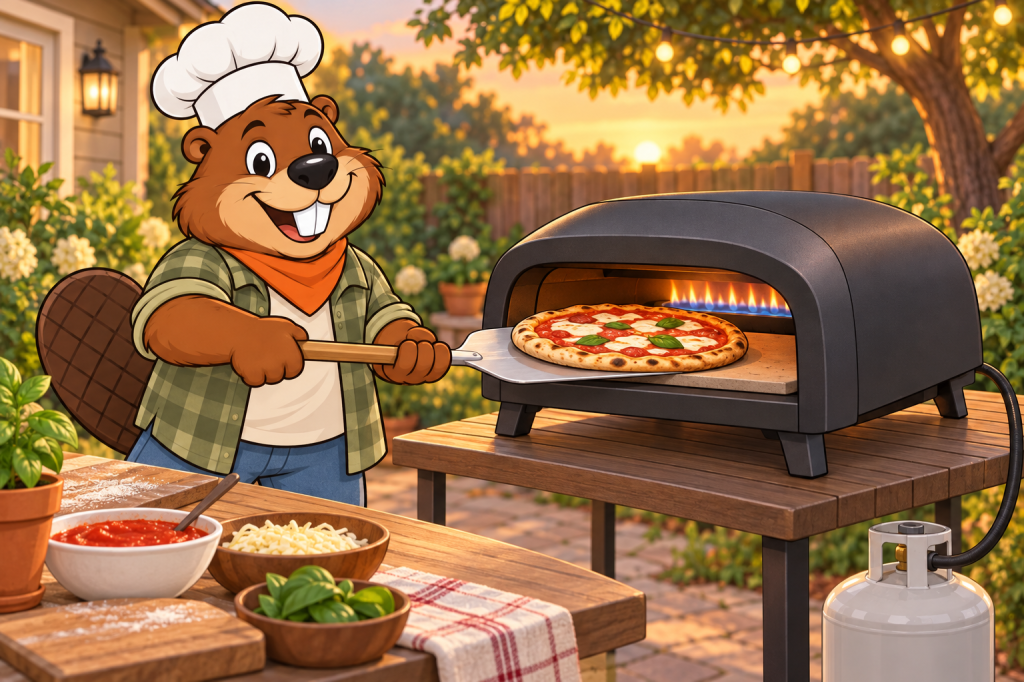
- Who it’s for: cooks who want a slightly bigger gas oven that handles a typical 14-inch home pizza.
- Fuel: propane.
- Size: 14-inch pizzas.
- Heat: ATK reports a 20- to 30-minute heat-up and an ambient temperature of 874°F.
- Price: over $300 at Ooni’s US store (October 4, 2026).
What the testers say: America’s Test Kitchen named it the winner of its outdoor pizza oven test. Setup is easy, the powerful rear burner and a flame-shielding visor brown the toppings well, the 14-inch stone fits the pizzas most people make at home, and its weight keeps it sitting securely on a table (America’s Test Kitchen).
One honest caveat from the testers: it’s powerful enough that you need to watch it closely to avoid burning, and some testers needed help moving it (America’s Test Kitchen).
Good for: cooks who want a 14-inch stone and gas convenience. Not for: walking away mid-bake. It’s powerful enough to burn a pizza if you don’t watch it.
Best for real fire: Ooni Karu 2

- Who it’s for: people who want live wood or charcoal flame, with the option to add gas later.
- Fuel: wood or charcoal; Ooni sells a gas burner separately.
- Size: 12-inch pizzas.
- Heat: Tom’s Guide reports 10 to 12 minutes to reach 750°F.
- Price: over $300 at Ooni’s US store (October 4, 2026).
What the testers say: Tom’s Guide named it Best Overall in its pizza oven guide for its fuel flexibility, quick assembly (under 15 minutes) and how well it serves a small group (Tom’s Guide).
One honest caveat from the testers: it isn’t sized for big parties, and the temperature needs active attention (Tom’s Guide). That’s the trade with any live fire. You get more flavor and more show, and you do more babysitting.
Good for: live wood or charcoal fire for a small group. Not for: big parties, or anyone who wants hands-off temperature.
The big backyard splurge: Gozney Dome (Gen 2)

- Who it’s for: serious enthusiasts who make lots of pizza and want a permanent backyard oven that also roasts and bakes.
- Fuel: wood, charcoal or propane (natural gas in some regions).
- Size: one 16-inch pizza or two 10-inch pizzas; about 137 lb.
- Heat: Food Network reports a 950°F maximum and about 40 minutes to heat; TechRadar timed 40 to 45 minutes.
- Price: over $300 at Gozney’s US store (October 4, 2026).
What the testers say: Food Network named it Best Professional-Grade. It arrives fully assembled, has an extra-large cooking surface and a digital thermometer with two probes, and carries a 5-year warranty (Food Network). TechRadar gave it Editor’s Choice and called it one of the best off-the-shelf pizza ovens money can buy, praising the dual stone and air temperature display and the even gas burner (TechRadar).
One honest caveat from the testers: it’s expensive, big and slow to heat, and TechRadar notes the wood-fire control kit is sold separately (in the $200–300 range). Their advice is simple. It’s for people who make pizza often, and casual cooks are better off with a cheaper model (TechRadar). Gerzsi notes that at 137 lb, this is the one oven that actually deserves a stone base.
Good for: people who make pizza often and want a permanent backyard oven. Not for: casual cooks. Testers say they are better off with a cheaper model.
The one thing to buy with any pizza oven: a peel
The oven does the cooking, but the peel gets the pizza in, turns it and pulls it out, and at 90 seconds a pizza there is no time to improvise with a cutting board. America’s Test Kitchen tested baking peels in February 2025 and found that the two classic styles do different jobs. A wooden peel is best for sliding raw dough in. A thin metal peel is best for turning the pizza and pulling it out. If you have the room, they suggest owning one of each (America’s Test Kitchen).
- ATK’s winner: EXO Non-Stick Super Peel Pro. A “conveyor belt” system rolls raw dough off the peel, so unloading is easy, and it turns and removes pizzas fairly well. The catch: it’s fussy to set up and clean, the thin handle is uncomfortable, and it costs more than the others.
- Best wood peel: New Star Foodservice 16 x 14 inch. Unloads raw dough almost as well as the winner and has a comfortable handle. The thick blade makes turning and pulling out harder, so keep tongs nearby.
- Best metal peel: American Metalcraft 2814. A thin aluminum blade that’s great at turning and pulling out pizzas. Raw dough sticks to it, so use plenty of flour or parchment to load.
All three from America’s Test Kitchen, February 14, 2025.
What matters in a backyard pizza oven
Fuel
Propane is the easy route. You turn a dial and adjust the flame. Wood and charcoal give you live fire but need more work. America’s Test Kitchen found that multi-fuel ovens require more attention and messier cleanup when burning wood or charcoal, and that small wood chambers make the fire hard to maintain (America’s Test Kitchen).
Size
ATK considers a 14-inch stone ideal for the pizzas most people make at home (America’s Test Kitchen). A 12-inch oven is fine for a couple or small family; go 16 inches only if you regularly feed a crowd.
Heat
All four ovens here get far hotter than a kitchen oven. The difference is control. America’s Test Kitchen warns that its winning oven needs close watching to avoid burning, and that the hottest oven in its test, the Ooni Koda 2 Pro, tended to burn the outside of pizzas (America’s Test Kitchen).
Chef Tamás’s note: In a professional kitchen we heat the surface, not just the air. A pizza stone needs time to soak up heat all the way through; if the flame looks ready but the stone isn’t, you get a burnt top and a pale, soft bottom. Preheat fully, and give the stone a minute or two to recover between pizzas.
Portability
Weight decides whether an oven lives on a table you can move or stays put. The Pi Prime is about 30 lb (Food Network); the Dome is about 137 lb and, as Tom’s Guide said of the original Dome, not portable (Tom’s Guide).
Chef Tamás’s note: At these temperatures a pizza is done in a minute or two, so the oven is never the slow part. You are. Do it like a kitchen line: dough balls portioned, toppings in bowls, peel floured, everything within arm’s reach before the first pizza goes in. And go light on toppings. Wet, heavy toppings don’t cook through in 90 seconds.
Chef Tamás’s note: Take the dough out of the fridge well before you stretch it. Cold dough fights you and tears; dough at room temperature relaxes and stretches thin without a rolling pin.
Pizza oven FAQ
Should I get a gas or a wood-fired pizza oven?
For most people, gas. It’s quicker to light and easier to control, and all four picks here can run on propane (the Karu 2 with an add-on burner sold separately). Choose wood or charcoal if live fire is part of the fun for you; testers note it needs more attention and more cleanup (America’s Test Kitchen, Tom’s Guide).
How long does a pizza oven take to heat up?
Portable ovens take roughly 10 to 30 minutes. The Pi Prime needs under 15 minutes (Popular Science), and the Ooni Koda ovens need 20 to 30 (America’s Test Kitchen). A big insulated oven like the Gozney Dome takes about 40 minutes (Food Network).
How big an oven do I need?
America’s Test Kitchen calls a 14-inch stone ideal for typical home pizzas (America’s Test Kitchen). Smaller 12-inch ovens are lighter and cheaper but, as Tom’s Guide notes of the Karu 2, not sized for large parties (Tom’s Guide).
How fast does a pizza actually cook?
Fast. Popular Science’s tester cooked pizzas in about 90 seconds in the Pi Prime, up to three minutes with wetter toppings like fresh mozzarella (Popular Science). That’s why you rotate the pizza and never walk away.
The bottom line
For most backyards, the Solo Stove Pi Prime is the safest bet. Three independent testers rate it at or near the top, and it’s the least expensive oven here, though still over $300. Want a 14-inch stone? America’s Test Kitchen’s winner, the Ooni Koda 2, costs a little more. Want real fire? The Ooni Karu 2. Want a permanent outdoor oven, and have a plinth-building beaver on call? The Gozney Dome.
Read next
- The best countertop ovens
- The kitchen tools a head chef actually reaches for
- The gift finder: tested tools for the cook on your list
Chef-picked. Beaver-approved.
🦫 The Lodge Letter. Black Friday is November 27. We’ll email you when a tested pick actually drops, plus one story a week. No spam, he’s a beaver.
Sources
- America’s Test Kitchen: The Best Outdoor Pizza Ovens
- Food Network: Best Outdoor Pizza Ovens, Tested and Reviewed
- Tom’s Guide: Best pizza ovens: tested and rated
- Popular Science: Solo Stove Pi Prime review
- TechRadar: Gozney Dome (Gen 2) review
- Tom’s Guide: Gozney Dome review (original model)
- America’s Test Kitchen: The Best Baking Peels (February 14, 2025)
- Solo Stove: Pi Prime price
- Ooni: Koda 2 price
- Ooni: Karu 2 price and fuel options
- Gozney: Dome (Gen 2) price and specs
🛒 Shop this guide
Propane ovens
Wood or charcoal
Multi-fuel splurge
The peel
Affiliate links. Ratings come from the independent testers linked in the guide.
Want a real brick oven instead? Chicago Brick Oven
The four ovens above are portable. A brick oven is a different animal: heavy, permanent, slow to heat, and it holds that heat for hours, so you can bake bread and roast meat after the pizzas are done. Chicago Brick Oven makes these in the USA, from DIY kits you finish in stone to ready-made countertop ovens.
- Most popular size: the CBO-750, with a 38 x 28 inch cooking surface, room for two 12-inch pizzas at once (Chicago Brick Oven).
- Ready to use: the CBO-750 Countertop arrives pre-assembled and insulated, with a chimney, a peel, a cleaning brush and an infrared thermometer in the box.
- Heat-up: about 45 minutes, so plan ahead (BBQGuys).
- Price: a real investment. On Chicago Brick Oven’s own store in November 2026, the CBO-750 Countertop wood-fired oven was $6,199 and the CBO-750 DIY kit was $3,899; gas-and-wood hybrids cost more.
Honest note: none of the independent testers we use for this guide has tested a Chicago Brick Oven, so the facts here come from the maker and retailers. That’s also why it isn’t in the comparison table above.
Good for: a permanent outdoor kitchen and people who cook for a crowd. Not for: anyone who wants pizza 15 minutes after deciding to make it. Gerzsi looked at the 38-inch hearth and started measuring the garden for a plinth. Again.
Big Tony’s pizza night kit
The oven gets all the attention, but three small tools decide whether pizza night goes smoothly. Big Tony keeps all three on the ledge, in this order.
- 1. A peel to get the pizza in and out. America’s Test Kitchen’s winner is the EXO Super Peel, with a “conveyor belt” that rolls raw dough off (America’s Test Kitchen). More on peels in the guide above.
- 2. An infrared thermometer to read the stone. The flame can look ready while the stone is still cold. An infrared thermometer reads the surface from a distance. America’s Test Kitchen named the Etekcity Lasergrip 1022 its Best Buy, at about a third of its winner’s price (America’s Test Kitchen). Most useful on ovens without a built-in thermometer, like the Pi Prime.
- 3. The funny one: pizza scissors. Yes, scissors. The Dreamfarm Scizza has a flat foot that slides under the slice, so you cut and serve in one move. America’s Test Kitchen found its extra-long blades sharp and exact even with saucy, cheesy deep-dish pizza and heavy toppings (America’s Test Kitchen). Big Tony’s opinion of pizza wheels cannot be printed here.
⚠️ The one rule that matters most: outdoors only
Gas, wood and charcoal pizza ovens all make carbon monoxide, a gas you can’t see or smell. Solo Stove’s own manual warns not to use its pizza oven inside a structure, tent or vehicle, under a covered patio or awning, near open windows, or in tightly fenced spaces where the gas can build up (Solo Stove Pi manual). That means no garage, not even with the door open, and not “just this once” when it rains. Keep kids and pets well back too: testers found the Pi Prime’s body stays very hot for over an hour after cooking (Popular Science).
Affiliate links. Big Tony is made up; the test results are real. Read his story on his page.
🔥 Also read: Best pellet grills for a holiday turkey and ham · Best backpacking stoves for beginners · Best cordless drills for beginners (and as a gift)






Leave a Reply